New Funding Opportunities from NSF TIP Directorate: 
What Research Parks and Innovation Districts Need to Know
The National Science Foundation (NSF) through its Technology Innovation and Partnerships (TIP) Directorate is issuing the most important funding opportunities for research parks, innovation districts and tech hubs in NSF’s 75-year history.
NSF traditionally has funded individual university research investigators and engineering institutes, but TIP aims to advance emerging technologies, boost U.S. competitiveness, and accelerate research translation. Critical to U.S. competitiveness are physical places, including research parks, innovation districts, labs and tech accelerators, to conduct research, support entrepreneurs and engage in corporate university partnerships.
Two major TIP funding opportunities especially relevant to research parks and innovation districts are taking place in 2026:
Accelerating Research Translation (ART):
The goal of the ART program is to promote commercialization of research findings, foster collaboration between researchers and industry partners and encourage interdisciplinary approaches to scientific problem solving.
The NSF ART program presents a major opportunity for university research parks to deepen their role as engines of innovation translation. By partnering with their host institutions, and related tech transfer centers and entrepreneurial training on ART proposals, park and innovation districts can build sustainable infrastructure for moving research discoveries into societal and economic impact.
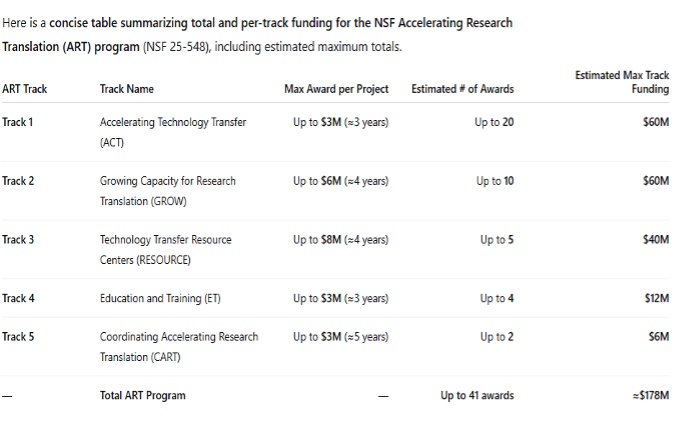
In 2026 NSF is expected to make up to 41 ART awards to universities and non-profits of approximately $178 million spread across 5 tracks:
Track 1 — Accelerating Technology Transfer (ACT)
Purpose: Build basic research translation capacity at institutions with low-to-medium readiness. Max award: up to $3 million per award over ~3 years.
Track 2 — Growing Capacity for Research Translation (GROW)
Purpose: Expand translation capacity at institutions with strong research but modest translation infrastructure. Max award: up to $6 million per award over ~4 years.
Track 3 — Technology Transfer Resource Centers (RESOURCE)
Purpose: Support regional centers that assist multiple institutions with low translation capacity. Max award: up to $8 million per center over ~4 years.
Track 4 — Education and Training (ET)
Purpose: Develop and deploy national education/training resources related to technology transfer and entrepreneurship. Max award: up to $3 million per award over ~3 years.
Track 5 — Coordinating Accelerating Research Translation (CART)
Purpose: Provide an integrated coordinating body across the ART tracks. Max award: up to $3 million per award over ~5 years.
Note submissions to NSF for Tracks 2 and 5 are due January 15, and Tracks 1, 3, and 4 are due March 12. See this link for details:https://www.nsf.gov/funding/opportunities/art-accelerating-research-translation
In the upcoming year, AURP plans to work with successful NSF ART grant applicants from the various Tracks to help build communities of innovation based on accelerating research translation in regions across the U.S.
NSF Tech Labs
The second ART funding opportunity is the NSF Tech Labs Initiative, which is expected to be released in 2026 after receiving input from stakeholders through an RFI. Up to $1 billion in funding over 5 years is expected, depending on Congressional funding.
NSF announces new initiative to launch and scale a new generation of transformative independent research organizations to advance breakthrough science
The U.S. National Science Foundation Directorate for Technology, Innovation and Partnerships (NSF TIP) on Friday announced the launch of a new initiative designed to launch and scale a new generation of independent research organizations. These organizations will focus on technical challenges and bottlenecks that traditional university and industry labs cannot easily solve on their own. NSF seeks feedback on this initiative through a Request for Information (RFI).
Details on funding opportunities are still to be determined through the RFI process but one of the principles is that this funding is to be managed by independent research organizations, not universities themselves. Research parks and innovation districts have a long history of supporting these types of organizations. Xerox PARC (Palo Alto Research Center) adjacent to Stanford Research Park is just one example. Accordingly, research parks and innovation districts are potential bridges between traditional universities and tech-adjacent clusters and homes to these new NSF-Tech Labs. Additionally, NSF is looking at supporting incubators and accelerators through this program.
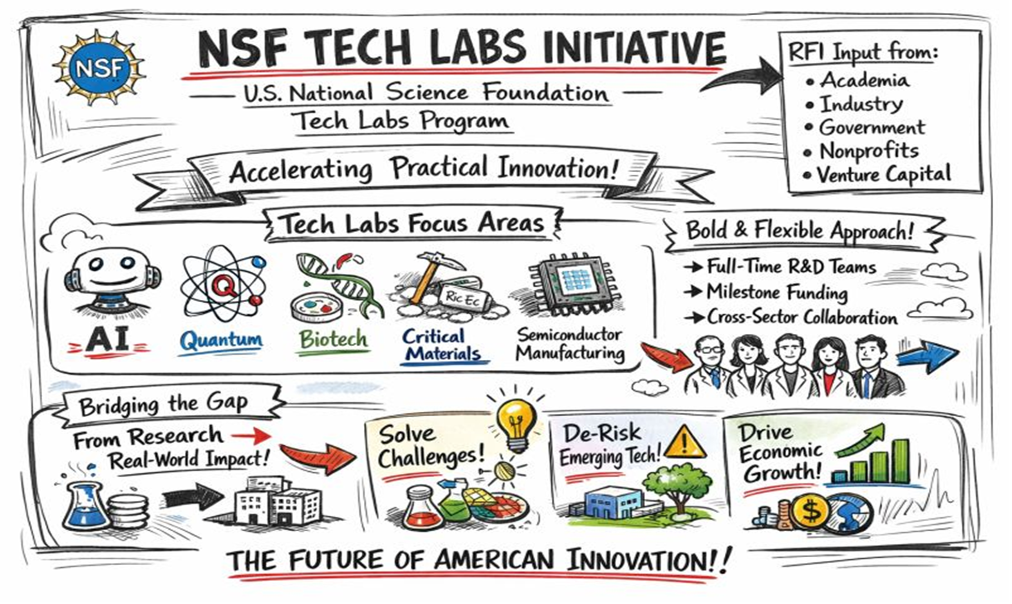
ChatGPT Image suggested by John Bailey
Caleb Watney, co-founder of the Institute for Progress, https://ifp.org/ is one of the thought leaders behind the Tech Labs Initiative and authored an excellent article in the Wall Street Journal on the opportunities this initiative presents to U.S. competitiveness.
AURP will submit comments on the Tech Labs Initiative on the role parks and innovation districts can play in supporting the initiative and will continue to monitor information of submission dates to NSF for Tech Labs as they become available.
How Research Parks, Innovation Districts and Related Stakeholders can connect and continue conversations regarding these two NSF TIP Funding opportunities:
AUTM Annual Conference: Seattle, Washington February 8-11, 2026
This is the largest gathering of tech transfer professionals from around the globe. AURP will have representation there to link with groups accelerating technology adoption. https://autm.net/2026/home
AURP Spring Training: Tempe, Arizona March 9-12, 2026
This is the annual master class for AURP members that will include a module on public-private partnerships and how they might be employed for research translation and tech labs https://aurp.org/education/spring-training/
University of Maryland Mpact Conference, College Park Maryland March 25-26, 2026
This conference focuses on Understanding Regional Opportunities and Partnerships to Drive American Competitiveness and will include talk by the NSF TIP Director and representatives from foundations and universities across the country. https://mpact2026.umd.edu/
AURP International Conference, Pegasus Park, Dallas, Texas, September 28-October 2, 2026
The annual AURP gathering will take place at Pegasus Park, a 26-acre future-focused campus dedicated to innovative companies and organizations across science, technology, healthcare, and social impact. Talent from the region’s best universities, biotech organizations, nonprofits, startups, investment groups, accelerators and incubators are hard at work building what’s next. AURP will be inviting representatives from NSF to speak as Pegasus Park has many of the attributes NSF is looking for in its Tech Labs Initiative. Registration starts later in the year. www.aurp.org
Questions on NSF TIP? Send them to:
Brian Darmody, Chief Strategy Officer, AURP
briandarmody@aurp.org