

Economic Impact of University Research Parks
Sandia National Laboratories’ 2025 Economic Impact Report
Sandia National Laboratories has a robust and widespread economic impact. Spending by the Labs exceeds $5.2 billion a year. Over $1.6 billion goes to subcontracts. That includes about $1.03 billion in subcontracts with small businesses. Explore the links below to learn more about the specific ways Sandia is making a difference at our headquarters in New Mexico and our second principal laboratory in California.

University of Georgia Research 2025 Impact Report
Across its 19 colleges and schools, the University of Georgia conducts research with real, far-reaching impact on modern life. UGA research affects the food you put on your table. It can help you feel better when you wake up in the morning and recover more quickly from disease. It influences where and how you travel, who and what you’ll encounter. At the end of the day, UGA research helps you thrive. We invite you to explore this 2025 Impact Report and learn more about how UGA research touches the world around you.
LSU’s The President’s Annual Impact Report 2024-2025
In 2024-25, LSU delivered a landmark year of progress with record-setting enrollments, more than half a billion dollars in research activity, and a surge in degrees awarded across campuses. That impact translated into thousands of jobs supported, billions in economic contributions to Louisiana, and major breakthroughs in fields such as healthcare (including development of a new class of antibiotics), energy innovation, agriculture and environmental resilience, cybersecurity, and national-security research. Through investments in new facilities, expanded academic programs, and partnerships across industry and government, LSU strengthened its role as a driver of opportunity, innovation, and long-term prosperity for the state.
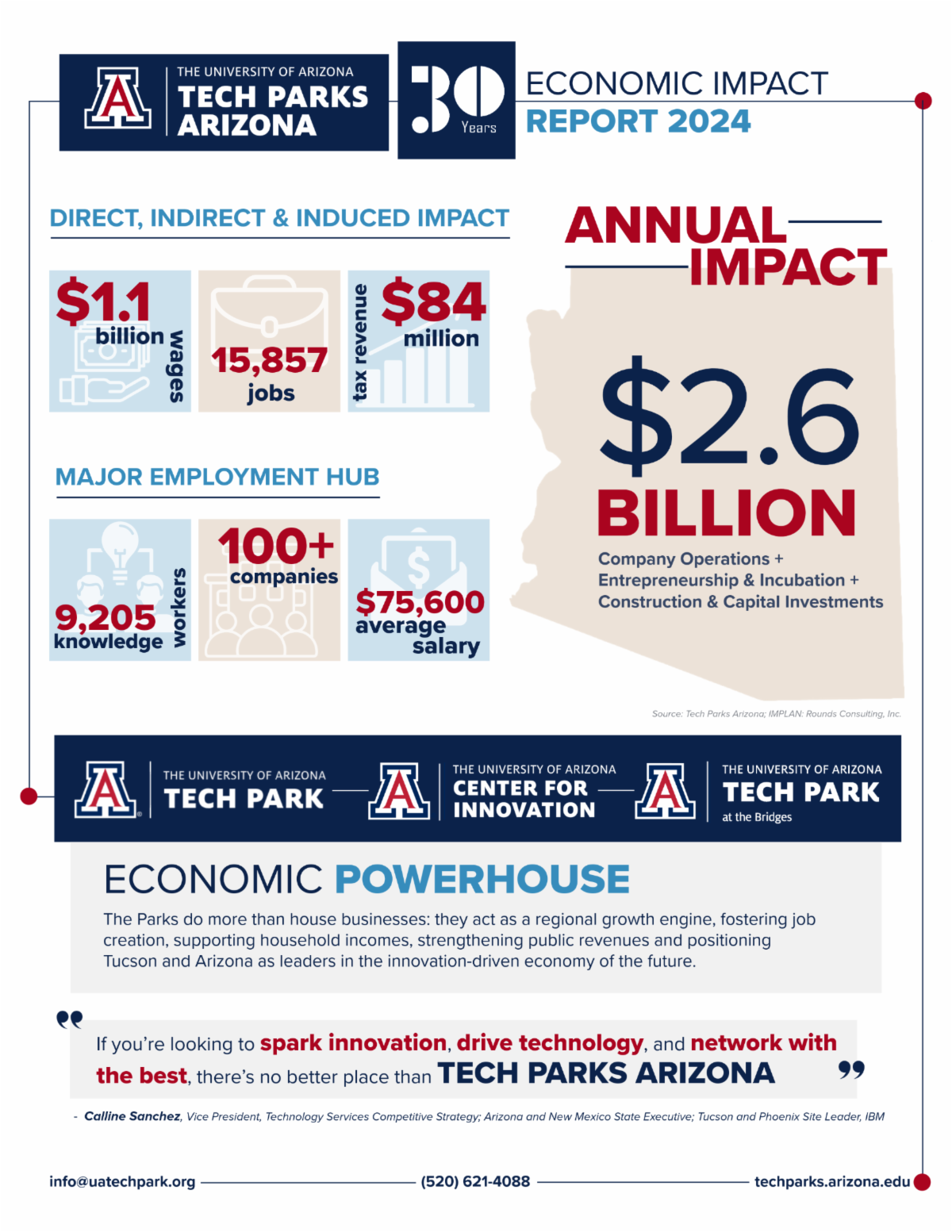
Tech Parks AZ Drives $2.6B Annual Economic Impact, Fueling High-Quality Jobs for Skilled Talent
Tech Parks Arizona marked its 30th anniversary with a new economic impact report revealing a $2.6 billion annual contribution to Arizona’s economy.
The report highlights that in 2024 alone, the organization supported 15,857 jobs, generated $1.1 billion in labor income, and produced $84 million in state and local tax revenues through its three innovation hubs — the UA Tech Park at Rita, UA Tech Park at The Bridges and the University of Arizona Center for Innovation.
“Tech Parks Arizona stands among North America’s leading university research and technology parks, exemplifying the best practices in innovation-driven economic development,” says Vickie Palmer, AURP CEO. “This newly released impact analysis reaffirms Tech Parks Arizona’s critical role as a national model — successfully linking academic research, industry collaboration and entrepreneurial growth to generate extraordinary economic outcomes.”

A new report from the University of Kentucky (home to the Coldstream Research Campus) on the state’s economy highlights both the state’s growing diversity and its persistent rural–urban disparities.
While rural Kentucky experienced population decline from 2011 to 2019, the trend reversed between 2020 and 2024 as more people moved to counties bordering urban centers — supported by expanded remote and hybrid work options. Despite this modest rebound, economic growth remains uneven: from 2001 to 2023, GDP grew by 49% in Kentucky’s 35 urban counties compared to just 18% in its 85 rural ones.
The analysis shows that rural residents earn, on average, 26% less per capita than urban residents, and even those with bachelor’s degrees make 40% less than their urban counterparts. Manufacturing remains the largest contributor to state GDP but represents a shrinking share of employment, while service and logistics jobs are expanding fastest. Rural areas also host a greater share of small firms (under 500 employees), yet their workers consistently earn lower wages across company sizes and ages.

Fiscal Year 2025 was a landmark year for research commercialization at the University of Michigan. Our office received 673 invention reports from our talented faculty and staff, setting a new record for creativity and discovery. In addition, we executed 326 license agreements and for the second time in our office’s history we supported the launch of 31 new startups. These achievements underscore the university’s commitment to translating groundbreaking research into tangible benefits.
Additionally, we executed 135 sponsored research agreements with company partners totalling more than $32.9 million in value — a significant contribution to the university’s total of $170.6 million in corporate sponsored research awards. These corporate research alliances enable our researchers to drive real- world, scalable solutions across vital fields ranging from biotechnology to mobility to climate resilience.

Founded in 1876 as the nation’s first research university, The Johns Hopkins University and shortly thereafter The Johns Hopkins Hospital have grown into global leaders in education, healthcare, and scientific innovation. Today, Johns Hopkins is not only a hub for discovery and knowledge creation—it is also an anchor institution with deep economic and social ties to Baltimore, Maryland, and the broader Mid-Atlantic region. With more than 70,000 employees, multiple academic campuses, major hospitals, research facilities, and affiliates across several states, Johns Hopkins is one of the most significant drivers of regional growth and opportunity.
Morgan State University is a premier public teaching and research institution located in Baltimore, Maryland. It is well regarded for its academic rigor, cutting edge research and public service efforts. As a Historically Black College and University (HBCU), Morgan has a well-documented history of providing opportunities for African American students to excel, particularly in the engineering and science fields. It also seeks to serve a diverse student body from all backgrounds, while producing high quality graduates that are successfully prepared to serve in a global society.
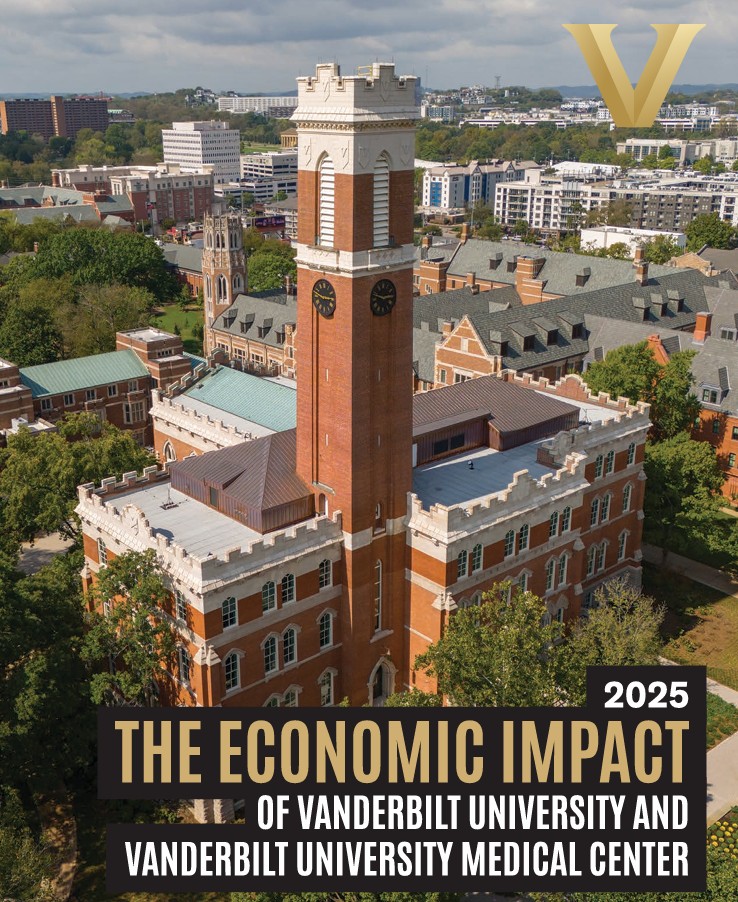
Vanderbilt-related activity accounted for almost $10 billion being directly spent in the Nashville area last year, the largest share of which is associated with VUMC. This creates a significant impact on the local economy, yielding a total of $22.13 billion in output, $13.17 billion in value-added (the local equivalent of GDP), earnings of $7.46 billion and more than 120,000 jobs.

The Alabama Productivity Center (APC) focuses research and educational resources on the enhancement of productivity and quality within Alabama businesses. APC works directly with businesses, organizations and government agencies throughout Alabama to increase their efficiency, provide cost-saving solutions and improve overall productivity.
The APC is home to Region 3 of the Alabama Technology Network, the Manufacturing Extension Partnership program of the National Institute of Standards and Technology for the state of Alabama.
For more information about APC, visit https://apc.ua.edu/.
Archived Economic Impact Studies
2025 Economic Impact Reports
2024 Economic Impact Reports
2023 Economic Impact Reports
- Auburn University Economic Impact Study – 2023
- The Beach at UNO 2023 Annual Report
- The 2023 Economic Impact of the University of Cambridge
- Florida Atlantic University Research 2023 Momentum Report
- Oxford University’s impact report for 2023, Oxford’s Impact Odyssey
- Rutgers University’s Research 2023 impact report
- San Diego State University (SDSU) Research Foundation 2023 Annual Report FY 2022-23
- UMass 2022 Economic Contribution Analysis report
- University City Science Center “Stories Behind Numbers” 2023 Impact Report
- University of Cincinnati’s 2023 Economic Impact Study
- University of Kentucky’s Economic Development Collaborative 2023 Annual Report.
- University of Wisconsin-Madison’s Discovery to Product (D2P) 2023 Annual Impact Report
- University of Tennessee-Knoxville’s Research Park at Cherokee Farm 2023 Annual Report
- The U.S. Bioscience Economy: Driving Economic Growth and Opportunity in States and Regions
- 2023 Wichita State Annual Report
2022 Economic Impact Reports
- BioForward Wisconsin’s Report on Its “Wisconsin Biohealth: Industry Landscape and Economic Impact Report”
- Research Park at Florida Atlantic University 2022 Report to the Community
- The Economic Value to Washington, D.C. of George Washington University and the Medical Faculty Associates
- The Economic Impact of LSU on Louisiana
- Oklahoma City Innovation District’s Report on Its “Impact Through Programming in 2022
- Purdue Research Foundation’s FY2021-2022 Annual Report
- Economic Impact Assessment – Sandia Science & Technology Park
- The Beach at the University of New Orleans 2022 Annual Report
- University of Delaware’s 2022 impact study
- University of Delaware’s report on its economic impact on the community and region
- University of Illinois’s 2022 Analysis of the Economic Impact and Return on Investment of Education
- The Statewide Economic Impact of the University of New Mexico 2022 Impact Report
- University Research Park (University of Wisconsin-Madison) 2022 impact report, Advancing Innovation
- Wichita State University’s 2022 Impact Report
2021 Economic Impact Reports
- JobsOhio “The Future is Ohio” 2021 Annual Report and 2022 Strategic Plan
- MaRS Discovery District: Meaningful Innovation – Impact Report (December 2021)
- Purdue Research Foundation’s FY2021-2022 Annual Report
- University of Arizona Tech Park Economic Impact Study
- University of Colorado’s research/economic impact study on the state’s economy
- University of Kentucky Coldstream Research Campus in its 2021 Annual Report
- University of Illinois Research Park Economic Impact Report 2021
- University of South Florida Economic Impact Report 2021
- University of Wisconsin-Madison’s Economic Impact + Innovation Report