

AURP’s Brian Darmody writes about two recent events focusing on the need for robust government, industry and university partnerships to keep the U.S. technologically competitive
In summer 2024, two key events focused on improving university-industry partnerships and highlighting the way the private sector is now funding more research and development across the country.
The first event, the KPMG Tech and Innovation Symposium held in Park City, UT, featured a fascinating discussion of private businesses, thought leaders in AI, foundations, universities, and entrepreneurs. See symposium link here.
Private sector companies in attendance included Apple, Google, IBM, Microsoft, plus numerous other private firms working on AI and machine learning in future technology and its impact on businesses and universities.
 The Symposium shared highlights on Tech Hubs and Universities Designing for Tomorrow with interactive displays and discussion organized by UIDP Collab and KPMG. This display highlighted the role tech hubs and universities are designing for tomorrow with representative examples from NC, NM, GA, PA, plus other regions of the country that have won NSF and EDA Tech Hub funding.
Universities and affiliated organizations present included UIDP, AURP, The University Financing Foundation, University of Maryland, Georgia Institute of Technology, North Dakota State University, University of North Carolina, University of Texas-Austin, University of New Mexico, University of California-San Diego, Furman, Tulane, Vanderbilt University, and Carnegie Mellon University, and Idaho National Laboratory.
Salim Ismail, Open ExO Founder, opened the Symposium with the keynote address on Solving the Innovator’s Dilemma, in which he focused on the critical role “edge organizations” can play to help established companies utilize disruptions from innovative technologies such as AI and machine learning.
The role of “edge organizations” in helping navigate change and business opportunities is not limited to private businesses. Historically, public universities have used affiliated foundations to engage in fundraising from students, alumni, and businesses.
However, universities are increasingly exploring use of “edge organizations” and affiliated foundations in other areas, such as tech transfer, (the University of Wisconsin Alumni Foundation is an early example), research administration (Purdue Research Foundation is an example at a public university), corporate engagement (Georgia Tech Research Institute), and research park/innovation district real estate development (Terrapin Development Corporation at University of Maryland).
States, cities, counties, and regions have experimented with similar quasi-governmental or purely private edge organizations to engage in economic development and tech development, such as Florida Economic Development Council, TEDCO in Maryland or JobsOhio.
A second, and equally important event, held earlier this summer in Washington D.C., was hosted by the National Academy of Sciences on The State of Science. This conference looked at changes in the profile of R&D funding since the time Vannevar Bush, as Director of the Office of Scientific Research and Development, issued the path-breaking Science, the Endless Frontier, in 1945.
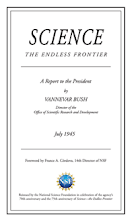 That report stimulated the fundamental role the federal government would play in supporting basic R&D after WWII for national security, prosperity and health. The report led to the founding of the National Science Foundation (NSF).
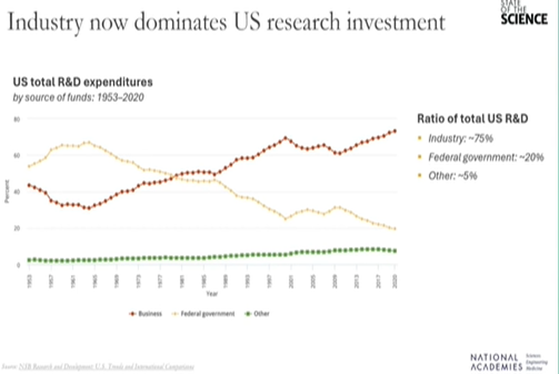
 The State of Science 2024 report highlighted the growth of R&D by the private and philanthropic sectors in the U.S over the past three decades, something Vannevar Bush might not have predicted.
As the following charts from the National Academies event demonstrates, the growth of industry-funded R&D in the U.S. now far exceeds federal funding.
Surprisingly, while corporations now dominate in funding U.S.-based R&D, the percentage of university-based basic research funded by the private sector has declined since the 1950s – from over 10% in 1953 down to 7% in 2021.
Federal, philanthropic, and internal university funding are current contributors to funding basic research at universities, but the share from federal funding at universities has declined since the early 1960s.
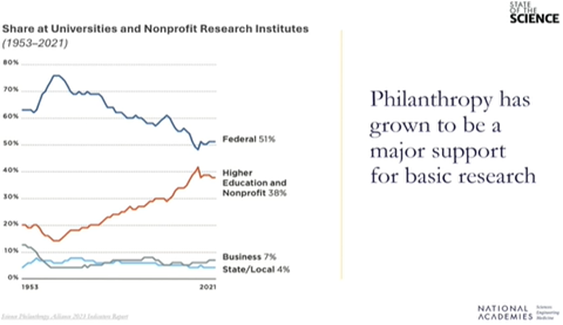
Note: business funding for research and development research at universities in 1953 exceeded 10% and by 2021 declined to 7%.
With national budget deficits looming, it is unlikely that federal investment in basic R&D funding will grow substantially in the future, but the federal funding sector is likely to remain the only one with comprehensive, open access funding for universities and other non-profit organizations.
As discussed at both the Symposium and the National Academy of Sciences event, funding for R&D by private U.S. firms has exploded, surpassing that of the federal government in the 1980s and now constituting about 75% of total R&D in the country.
Recent NSF data shows the private sector is becoming a dominant funder of basic research, an area historically dominated by the federal sector as a mainstay of university research activity.
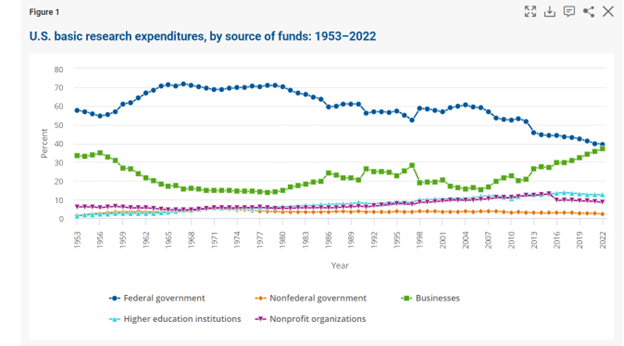
*NSF data 2023
The federal government remains the dominant funder of open basic research in the U.S., as it is the only national organization that supports long term research. Nevertheless, both events in D.C. and Utah demonstrated the critical importance for higher education to adapt to new funding opportunities and develop agile “edge organizations” in research administration, real estate, tech transfer and corporate development and business enterprise models to take advantage of future opportunities.
Based on discussions at both National Academies State of Science and KPMG Tech Symposium some takeaways are:
- For universities: build robust industry-university partnership offices as part of the university’s division of research; plus, continue to develop and invest in one-stop shops for corporate and foundation engagement and utilize “edge organizations” to get around institutional barriers that can thwart robust university-industry-foundation-government partnerships. Build university research parks and innovation districts to provide space for private companies to locate proximate to higher education facilities. Connect with other higher education institutions in your region to build coalitions to collectively advance tech-based economic prosperity.
- For companies: invest more heavily in partnerships with universities. Explore use of broader requests for partnerships to engage universities in a region. Create new pathways to upskill students in emerging technologies. For example, giving industry researchers in AI release time to become professors of practice to teach at universities is a practical way to ensure universities continue to graduate students with the latest technology background.
- For the federal government: continued investment in basic and applied research as outlined in the bipartisan CHIPS and Science Act is necessary. The federal government will continue to be the major source of funding at universities, but it can also play a catalyst role linking private sector research with university-based opportunities as the new TIP (Technology Innovation and Partnership) Directorate that is the first new NSF Directorate in decades. The federal government should encourage the development of university-industry partnerships around federal labs through research parks and innovation districts, such as Sandia Science & Technology Park in New Mexico. Just as importantly, the federal government should avoid ill-considered policies such as the proposed March-In Rights framework that threatens to undermine one of the most inspired public policies that stimulated university tech commercialization: the Bayh-Dole Act.
In summary: funding streams for U.S.-based R&D has changed radically since the 1950s with the emergence of the private sector as a major player.
National non-profit organizations such as UIPD, AURP, AUTM, NACRO and UEDA, plus numerous others, help universities and the private sector navigate ways to increase partnerships and publicize best practices. See the appendix below for connections to these groups.
To keep the U.S technologically competitive, it is vital that governments, industry, and universities adapt and continue to work together to find new ways to connect, expand research partnerships, and achieve technological breakthroughs as has been done since the 1950s. As a major funder of R&D, making sure the private sector is engaged will remain critical.
Appendix:
Organizations supporting research, industry-university-government partnerships, research commercialization, entrepreneurship, and building communities of innovation in the U.S. and around the globe:
Association of University Research Parks (AURP)
The University Financing Foundation (TUFF)
International Business Innovation Association (InBIA)
Network of Academic Corporate Relations Officers(NACRO)
University Economic Development Association (UEDA)
Association of Public and Land-grant Universities (APLU)
Federal Lab Consortium for Technology Transfer (FLC)
State Science & Technology Institute (SSTI)
University Industry Innovation Network (UIIN)
Government-University-Industry Research Roundtable(GUIRR)
—————————————————————————————————————–
This AURP report prepared by:
Brian Darmody, Chief Strategy Officer for AURP (Association of University Research Parks), a nonprofit organization of university, federal and regional communities of innovation with members in 46 states plus the firms that plan, build and manage these facilities. Previously, Brian worked at the University of Maryland in College Park in a variety of roles, including tech transfer, corporate relations, research administration, government relations and legal office. Brian is based in the AURP DC Area office in College Park, Maryland.
About AURP:
AURP, a nonprofit international organization with offices in the Washington, DC area at the University of Maryland Discovery District and in Tucson, AZ at the University of Arizona Tech Park, focuses on creating communities of innovation and education for research parks both operating and planned, plus innovation districts, incubators, accelerators and the businesses that support the research park industry. AURP and its global membership promote research, institute-industry relations and innovation districts to foster innovation and to facilitate the transfer of technology from such institutions to the private sector. Learn more: www.aurp.net